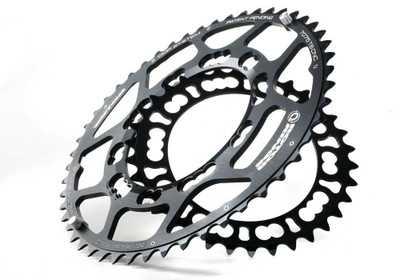

Q-Rings are oval chainrings with variable tooth spacing that reduce dead spots and
optimize power delivery during pedaling.
The Q-Ring chainring has two distinct zones: one with increasing gear ratio and the other
decreasing.
The increasing gear ratio zone is where the leg muscles, during the pedaling action,
pedaling, are capable of developing their full power. The Q-Ring chainring, at that specific moment,
, increases the gear ratio by 2.6 teeth compared to the
of the original chainring (if we use a 53-tooth Q-Ring chainring, in the zone of maximum
ovalization, it will be equivalent to a 55.6-tooth chainring) in order to make the most of
all the power we generate and avoid wasting energy. Immediately after
passing that specific point of maximum force, the gear ratio begins to decrease
progressively until it reaches its minimum gear ratio at the dead center (in this
case, the chainring will have decreased by 2.6 teeth. Using a 53-tooth Q-Ring chainring, at
dead center, the gear ratio will be equivalent to that of a 50.4-tooth chainring). Past
top dead center, the gear ratio increases progressively again until the next
maximum effort.
During a full pedal revolution, the Q-Ring chainring passes through two zones of
maximum gear ratio and two minimized dead-center zones, achieving
optimized power delivery, a moderate increase in pedaling cadence
through the dead center zone, and a significant reduction in the harmful effects
of dead spot on the knee and muscles.
Both the maximum and minimum zones are proportional, and their increase and
decrease are progressive. The legs do not experience force spikes; rather, the pedaling,
naturally, becomes smoother and more harmonious, as the chainring helps the cyclist
modulate their force and apply it where it is needed. This perfect balance between the
extreme zones ensures that the bike’s mechanical components are not stressed and perceive the
Q-Ring chainring as if it were round. The chain is not subjected to jerks, nor does the derailleur experience
harmful tension, resulting in perfect shifting precision.
The ratio between maximum growth and minimum growth is proportional to
the diameter of the chainring. This ratio increases as the chainring gets larger and decreases
with smaller gear ratios, adapting the oval shape to every moment and situation
of pedaling.